
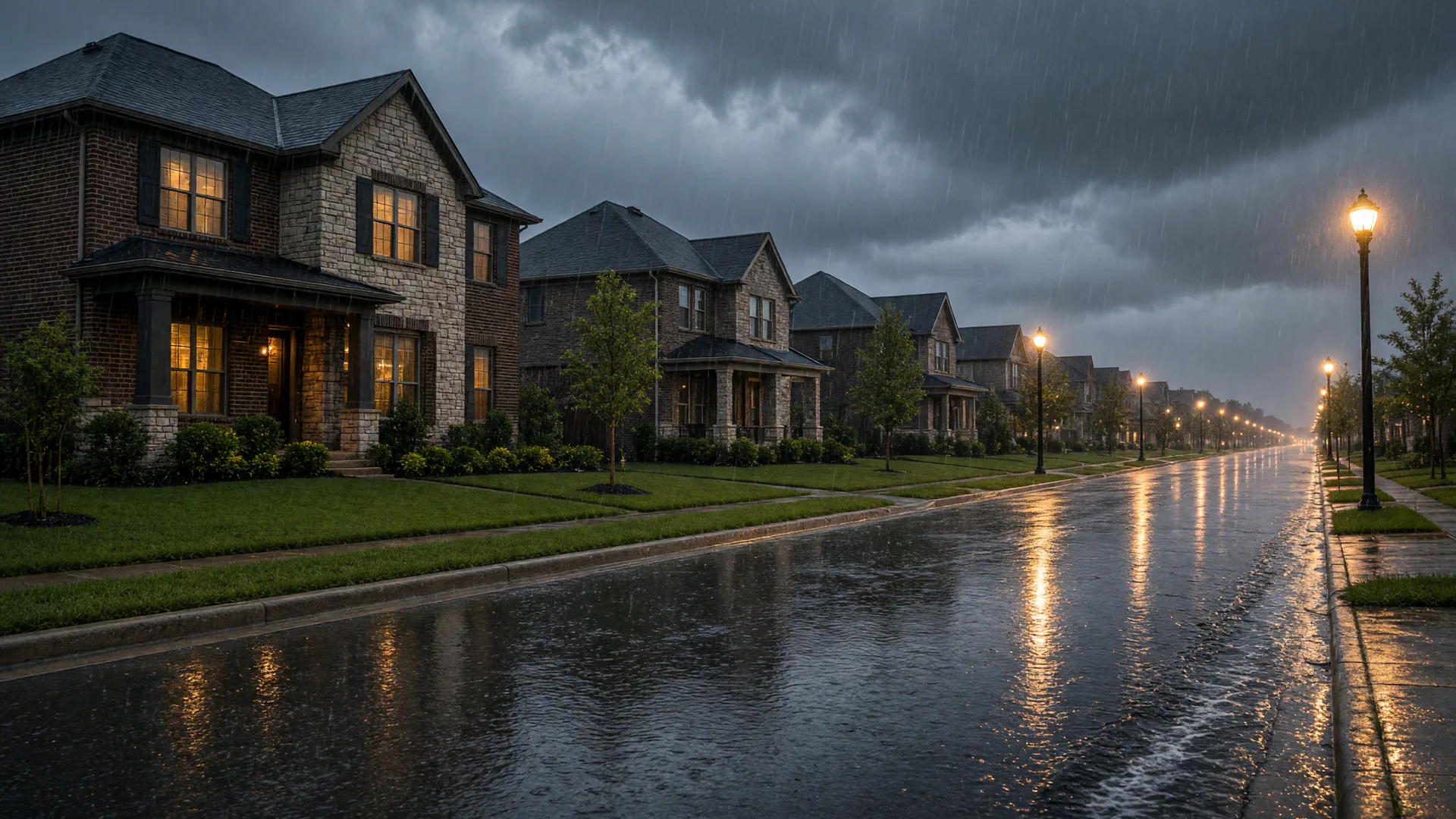
Do you need flood insurance to buy or own a home in Katy or Houston? The short answer: if the home sits in a FEMA Special Flood Hazard Area, the zone commonly called the 100-year floodplain, and you are using a federally backed mortgage, your lender will require flood insurance as a condition of the loan. If the home sits outside that zone, insurance is not required, but in the Houston area it is still worth taking seriously, because a large share of the flooding in Harris County happens outside the mapped high-risk zones. And in every case, your standard homeowners policy does not cover flood damage at all. Here is how the requirement, the cost, and the Texas disclosure rules actually work.
When flood insurance is required in Texas
The requirement comes from the federal Flood Disaster Protection Act of 1973, as amended. If a property is located in a FEMA-mapped Special Flood Hazard Area, the zone with a 1% or greater annual chance of flooding, and the mortgage is federally backed or comes from a federally regulated lender (which covers most conventional, FHA, and VA loans), flood insurance is mandatory as a condition of that loan. The coverage must generally be maintained for the life of the loan, at least to the lesser of the outstanding principal balance or the maximum NFIP coverage limit.
Practically, that means your lender runs a flood zone determination, usually through a third-party vendor, early in the mortgage process. If the address comes back in a Special Flood Hazard Area, flood insurance stops being an option and becomes a line item on your closing math. A private flood insurance policy can satisfy the requirement in many cases, and lenders may require coverage even in lower-risk zones at their own discretion. If you are paying all cash, nobody requires you to carry it, but the risk is the same as for everyone else.
Why the Houston area treats flood risk differently
Houston and its western suburbs sit on flat coastal prairie with clay soils and some of the highest rainfall totals of any major U.S. metro. The numbers from Hurricane Harvey in 2017 explain why flood questions never feel academic here. The Harris County Flood Control District's final Harvey report, published in June 2018, counted roughly 154,000 homes that flooded in Harris County, with about two-thirds of them outside the mapped 100-year floodplain and roughly 70,000 of them outside any mapped floodplain at all. Harvey caused an estimated $125 billion in damages region-wide, making it one of the costliest storms in American history.
The memory of that storm is built into the landscape. The federal Addicks and Barker reservoirs, built in the 1940s, sit in the corridor between Katy and the Energy Corridor west of Houston, and they provide flood control rather than recreation: federal records count nearly 14,000 homes inside the two reservoir footprints, and more than 5,000 of them flooded during Harvey. Katy itself spans Harris and Fort Bend counties, and Buffalo Bayou, the slow-moving waterway that runs through the heart of Houston, has its headwaters in the Katy area. Harris County created its Flood Control District in 1937, after the floods of 1929 and 1935, and it now maintains more than 2,500 miles of bayous and creeks and roughly 280 stormwater detention basins, which is why newer master-planned communities in Katy are built around detention ponds and engineered drainage. That infrastructure helps, and it is part of what buyers look at, but it does not make any address flood-proof.
The honest takeaway: FEMA's flood maps describe the flood risk that federal modeling has identified, not every place water can actually go. Two points of land a mile apart can carry very different risk, which is why the flood question has to be asked about a specific home, not about a whole city or zip code.
What your homeowners policy actually covers
Standard homeowners insurance in Texas does not cover flood damage. The distinction matters: a homeowners policy covers water that comes from inside your house, like a burst pipe or an overflowing toilet, but water that rises from outside, such as heavy rain ponding in your yard, a bayou over its banks, or storm surge, is flood, and it is excluded from the standard policy. Many Katy homeowners have been surprised by that boundary after a storm, which is exactly why flood insurance is a separate policy with a separate premium, and why it is worth pricing even for homes that sit outside the FEMA high-risk zones.
How much flood insurance costs under Risk Rating 2.0
The National Flood Insurance Program (NFIP) used to price policies mostly by flood zone. In 2021 FEMA introduced Risk Rating 2.0, its new pricing methodology, which was fully implemented for all policies by April 1, 2023. Under the new system, each property is priced on its own characteristics: elevation relative to flood levels, distance to water, the type and height of construction, the cost to rebuild, and other property-specific factors. That means two Katy homes can have very different premiums even in the same neighborhood.
So what does the price look like in practice? A few anchored figures:
- The national average NFIP premium is about $976 a year, or roughly $81 a month, per NerdWallet's 2026 analysis of NFIP rates. It is an average, not a prediction for your address.
- Lower-risk homes can be much cheaper. FEMA's Preferred Risk Policy, available for homes in low-to-moderate-risk zones, starts around $129 a year for building and contents combined, with typical premiums for lower-risk Houston-area homes in the roughly $200 to $500 a year range.
- Higher-risk properties cost more, within a limit. Annual premium increases are capped at 18% per year for most policies, so premiums step up gradually toward the full-risk rate rather than jumping all at once.
Coverage under the NFIP tops out at $250,000 for the building and $100,000 for contents, which is one reason buyers of higher-value Katy homes sometimes layer a private flood policy on top. Whatever the price, treat it as an annual cost of ownership, right next to property taxes and homeowners insurance. As a frame of reference, the total tax bill on a typical Katy home, explained in detail in our property tax guide, is usually several times any flood premium, but both belong in the monthly budget before you commit.
The 30-day waiting period and the closing exception
NFIP flood insurance does not take effect the day you buy it. Under federal regulation, new coverage has a 30-day waiting period: the policy goes into force 30 days after the application and full premium are submitted. That rule protects the program from people who buy a policy only when a hurricane is already bearing down on the Gulf Coast.
There is an important exception for buyers. When flood insurance is purchased in connection with making, increasing, extending, or renewing a loan, which includes a purchase mortgage and a refinance, there is no waiting period: coverage is effective at closing, provided the application and full premium are handled on time. That is how the flood policy lines up with your closing date instead of delaying it. For everyone else, the practical rule is simple: don't wait until the forecast calls for rain. If you buy a home in a mapped zone, or even near one, quote the flood policy when you quote the rest of your ownership costs, not in a panic during hurricane season.
What the Texas Seller's Disclosure asks about flooding
Texas law (Property Code Section 5.008) requires sellers of residential property to deliver a written Seller's Disclosure Notice before the buyer becomes obligated under the contract. After Hurricane Harvey, the Texas Legislature passed SB 339, effective September 1, 2019, which added specific flood-related questions to the notice. On the Texas Association of REALTORS form TXR-1406, which is the standard disclosure form used across the state, the flood section asks the seller whether they are aware of any of the following:
- Present flood insurance coverage on the property;
- Previous flooding due to a failure or breach of a reservoir, or a controlled or emergency release of water from a reservoir;
- Previous flooding due to a natural flood event;
- Previous water penetration into a structure due to a natural flood event;
- Whether the property is located wholly or partly in a 100-year floodplain;
- Whether the property is located wholly or partly in a 500-year floodplain; and
- Whether the property is located wholly or partly in a floodway.
The disclosure reflects the seller's actual knowledge, and it is not a warranty, but it is a legal document with consequences. A seller who knowingly misstates a flood condition can face liability for damages, and a buyer whose seller lied on the disclosure has real legal options. During your option period, which in a Texas resale is the roughly seven- to ten-day window to investigate, the disclosure is one of the first documents you should read closely, alongside the title work and the inspection report.
What buyers and sellers should actually do
For buyers, the flood homework is straightforward and mostly free. Read the Seller's Disclosure answers about flooding and water penetration. Check the FEMA flood map for the exact address through FloodSmart, the NFIP's public portal, and ask your lender for the flood zone determination on your file. Ask the seller directly how the house and street handled the last big rain, and talk to neighbors if you can. Drive the neighborhood during a hard rain if your timeline allows it, and note where water ponds. If the home is in or near a mapped zone, get a flood insurance quote early in the process, because the waiting period and the closing deadline both bite on a 45-day calendar. A buyer's agent who has done this hundreds of times will make sure the flood question is answered before the option period ends, not after. The current rules for how buyer representation works in Texas, including the written agreement required before showings, are spelled out in our buyer's agent explainer.
For sellers, the rule is equally simple: answer the disclosure truthfully, and know your property's flood history before you go under contract. If you have filed a flood insurance claim or pumped water out of a room, that belongs on the form. Order the FEMA data for your own address so you are never surprised at the table, and keep your gutters, downspouts, and the grading around your foundation in good shape, because those small details show up in the inspection report and in buyer questions. The full checklist of what to gather and fix before listing is on our preparing-to-sell page, and the disclosure is one of the first items on it.
The honest bottom line
Flood insurance in Katy and Houston is sometimes mandatory, often sensible, and never included in your homeowners policy. The mortgage requirement is driven by a mapped zone; the practical decision is driven by the fact that most of the flooding in this region has happened on ground the maps marked as lower risk. Price the policy while you are shopping, ask the flood questions while you still have the option period, and treat the premium as a permanent line in your ownership budget rather than a storm-season impulse. That is how the smartest buyers and sellers in Katy and West Houston have handled it, and it is how we coach our clients on every transaction we guide.
Want to know the flood story on a specific home?
Flood questions are best answered address by address, with the disclosure in one hand and the FEMA data in the other. If you are buying or selling in Katy or Greater Houston, call Carol at (832) 212-2772 or send a note through the contact page, and she will walk you through the flood zone, the disclosure questions, and what it all means for your specific transaction. No obligation, and no jargon.