
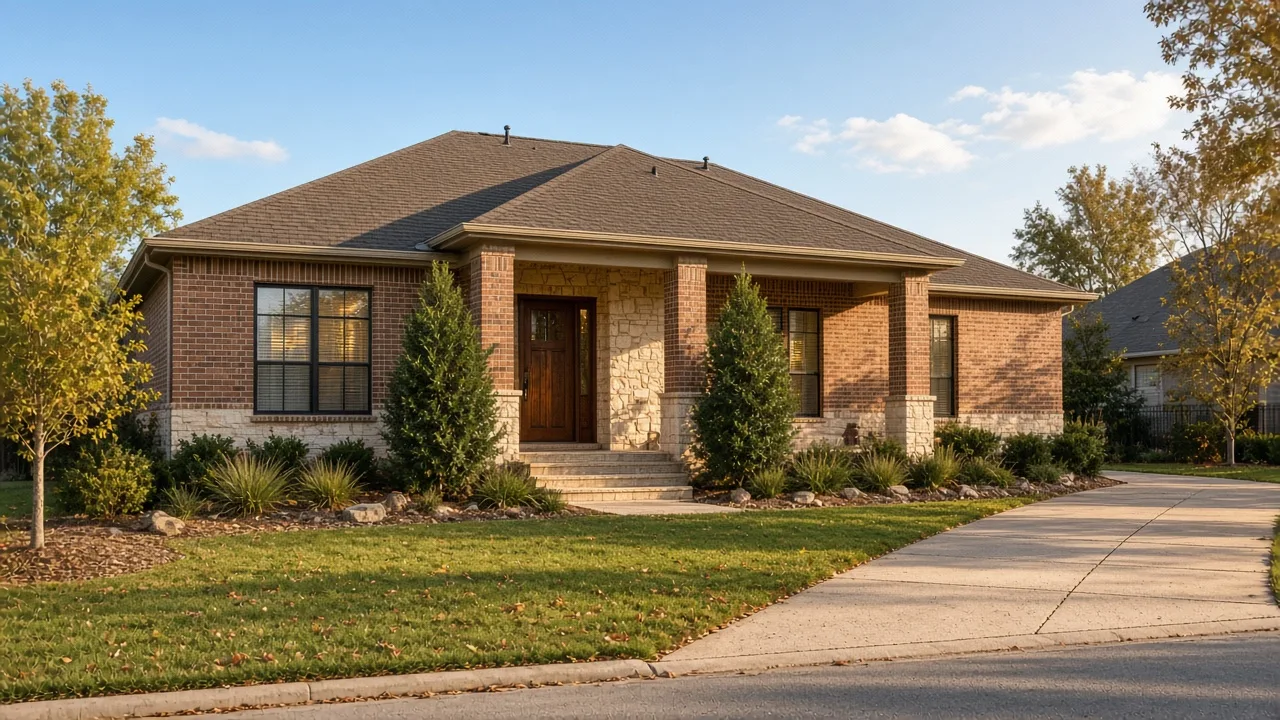
How much house can you afford in Katy, Texas? Start with two numbers: the monthly payment you can honestly carry, and your debt-to-income ratio, the share of your gross income that lenders use to gauge the risk. On HAR's September 2026 Katy median sale price of $334,900, a 20% down buyer at Freddie Mac's November 2026 30-year rate of 7.11% sees principal and interest of about $1,800 a month before property taxes, homeowners insurance, and HOA dues are added. Here is how to run your own numbers against real Katy costs, and what the total payment on that typical home tells you about the income it actually takes to buy comfortably.
Start with the monthly payment, not the price tag
Buyers often ask what price range they can stretch to. The more useful question is what monthly payment you can live with, because every Katy home carries ongoing costs that sit outside the mortgage itself. Your payment breaks into two groups:
- The mortgage payment itself: principal and interest on the loan, which follows the rate you lock and the down payment you make.
- The costs wrapped into escrow: property taxes, homeowners insurance, and, where it applies, private mortgage insurance (PMI) when your down payment is under 20%. In a Katy master-planned community, HOA dues are a separate bill on top of the payment.
A common trap is financing to the maximum mortgage the bank approves and discovering that taxes, insurance, and dues push the real monthly cost well above the number you planned around. The sections below put actual Katy figures next to a worked example so the total is not a surprise.
The two ratios lenders actually weight
When a lender sizes a mortgage, the two headline ratios are the front-end and back-end debt-to-income ratios. The widely cited rule of thumb is the 28/36 guideline: housing costs should stay at or below about 28% of your gross monthly income, and all of your monthly debt, housing plus car, student loans, credit cards, should stay at or below about 36%. Mortgage researchers and lender guides treat these as benchmarks for a comfortable, conventional purchase.
In practice, many automated underwriting systems can approve a higher back-end ratio, sometimes up to the 43% to 45% range, which lets a well-qualified buyer with strong credit carry more debt than the old 36% guide suggests. That does not mean the top of the approval range is a smart place to land. The best buyers keep a buffer, because homeownership adds repairs, maintenance, and the occasional big-ticket surprise that do not show up on a loan application. For the clearest picture, run the math at the conservative 28% front-end line and treat anything beyond it as the stretch zone.
What you are really financing on a median Katy home
Let's anchor on a concrete example so the numbers stay honest. HAR, the Houston Association of REALTORS, reported Katy's median sale price of $334,900 for September 2026, its official Katy price-trends figure (the median, not the average, which ran about $408,000 the same month). Median means half of Katy sales closed under that price and half above, so it is a fair middle ground, not a fixed budget.
With 20% down
On a $334,900 home with a 20% down payment, you finance $267,920. At Freddie Mac's surveyed 30-year fixed rate of 7.11% for the week of November 12, 2026, the principal and interest alone come to roughly $1,800 a month. Add the other costs and the total works out to about:
- Principal and interest: ~$1,800 on the $267,920 loan at 7.11%.
- Property taxes: roughly $370 to $520 a month, depending on the county and district. Katy ISD's 2026-27 rate is $1.1171 per $100, and county and MUD layers sit on top; our Katy property tax guide shows the full stack.
- Homeowners insurance: roughly $150 to $210 a month, a working estimate for a well-built home in the Houston area.
- HOA dues: roughly $50 to $135 a month, matching the typical Katy master-planned range below.
Add those together and a median-priced Katy home with 20% down, at today's rate, lands near $2,400 to $2,700 a month, call it about $2,500 in the middle. On the 28% front-end guideline, that payment needs roughly $8,900 a month in gross income, around $107,000 a year, to stay inside the conservative line. A household with no other debt could stretch toward it at a lower income, but the margin shrinks fast the closer you get to your real cost of living.
With 10% down
A 10% down payment, common for first-time buyers, finances $301,410 on the same median home. At 7.11% the principal and interest rise to about $2,030 a month, and the below-20% down payment adds private mortgage insurance, typically in the low hundreds a month, until your equity crosses the 20% mark. With taxes, insurance, HOA dues, and PMI added, the total sits closer to $3,000 to $3,200 a month, which on the 28% line implies a household income near $130,000 a year. That gap between 20% and 10% down, roughly $500 a month on this illustration, is a big reason a larger down payment, a lower home price, or a smaller condo or townhome (check our rent-versus-buy breakdown for how those compare in Katy) matters so much for first-time buyers.
The conforming loan limit matters above this range
There is a ceiling worth knowing before you shop. The Federal Housing Finance Agency set the 2026 conforming loan limit for a single-family home in Texas at $832,750, effective January 1, 2026, up from $806,500 in 2025. Standard conforming loans are eligible for the best pricing from Fannie Mae and Freddie Mac; a loan amount above the limit is a jumbo mortgage, which carries different underwriting and often a higher rate. Most Katy buyers, even at the area's higher price points, sit well under that ceiling, but if you are looking at luxury homes closer to West Houston, the conforming cap is the dividing line worth checking early.
Katy's property tax and HOA reality
Two local costs affect affordability more in Katy than in most of the country, and both belong in the monthly budget before you fall in love with a house.
Property taxes are the biggest. Texas has no state income tax, and Katy's local tax rates lean toward the higher end of national averages. The single largest line on almost every Katy bill is the school district: Katy ISD's FY 2026-27 rate is $1.1171 per $100 of assessed value, flat for a third year. County, city, and MUD layers stack on top, and because Katy sits across Harris, Fort Bend, and Waller counties, the total differs by address. The school share and the exemptions that trim it, including the state's $140,000 school homestead exemption, are detailed in our property tax guide. Budget for them as a recurring annual cost, because your lender collects a share each month into escrow.
HOA dues are standard, not unusual. Almost every Katy home is in a master-planned community with a homeowners association that maintains common areas, pools, trails, and neighborhood standards. Annual dues in most Katy communities run roughly $600 to $1,600 a year, a practical range that varies by community and lot size. Cinco Ranch, one of the largest, charges about $1,150 a year in many of its sections, with some near $1,600, and Firethorne on the southwest side runs roughly $600 to $1,100 depending on the section. Your agent can pull the exact HOA assessment for any specific property before you make an offer, so it is a known number, not a surprise at closing.
What lenders check beyond the ratios
The ratios are the headline, but pre-approval weighs several more things, and knowing them now saves you from finding out mid-contract:
- Credit score. Higher scores unlock the best rates, which matters enormously when every tenth of a point moves your payment by $30 to $40 a month.
- Stable income. Lenders want a history of consistent, documented earnings, which becomes a real question for self-employed buyers and those switching industries.
- Reserves. Money left on top of closing costs and down payment that a lender likes to see, typically a few months of the mortgage payment.
- Total monthly debt. Car loans, student loans, credit cards, and any other obligations count against your back-end ratio whether or not you carry a balance.
A formal pre-approval, not just a pre-qualification, is what lets a seller take your offer seriously in a competitive Katy market. If you are still early, the place to start is a clear budget conversation; our buying guide walks through the first steps, and the current buy-versus-wait picture in Katy puts today's rates and prices in context.
Rules of thumb that keep the math honest
Fractions and forecasts come and go, but a few durable rules keep any Katy purchase sane:
- Do not build your budget at the top of the approval. The maximum a lender will lend is not the amount you should borrow. Target 28% of gross income on housing, with room under it if you can.
- Add every ownership cost before you decide. Principal, interest, taxes, insurance, PMI, and HOA dues. Skip one and the budget is wrong.
- Keep a savings buffer for surprises. Your escrow and monthly budget cover scheduled costs, not the water heater that fails in year two. Homeownership always has a maintenance line.
- Let the neighborhood set the price. A condo or townhome in a great area will likely beat a stretched single-family home on the edge of your commute. Your agent can show you the range in Katy and across Greater Houston for your budget.
The honest bottom line
On Katy's September 2026 median of $334,900 and today's 7.11% rate, a 20% down buyer sits close to $2,500 a month all-in, which points to a household income around $107,000 a year on the conservative 28% line. A 10% down, lower budget, or a smaller home moves the needle down, and stretching 5% to the top of today's rates has little cushion. Run these numbers against your real income and debt before you schedule showings, get a formal pre-approval with the numbers in hand, and let taxes, insurance, and HOA dues be written into the budget, not discovered along the way. That is how buyers in Katy and West Houston close comfortably, and how we coach every buyer we guide.
Want your real number in the current market?
Rates, prices, and taxes shift month to month, and your personal debt picture matters as much as the market. If you are ready to buy in Katy or Greater Houston, call Carol at (832) 212-2772 or send a note through the contact page, and she will help you set a realistic budget, connect you with a lender you can trust, and pull the current listings and tax picture for the price range that fits. No obligation, and no jargon.