
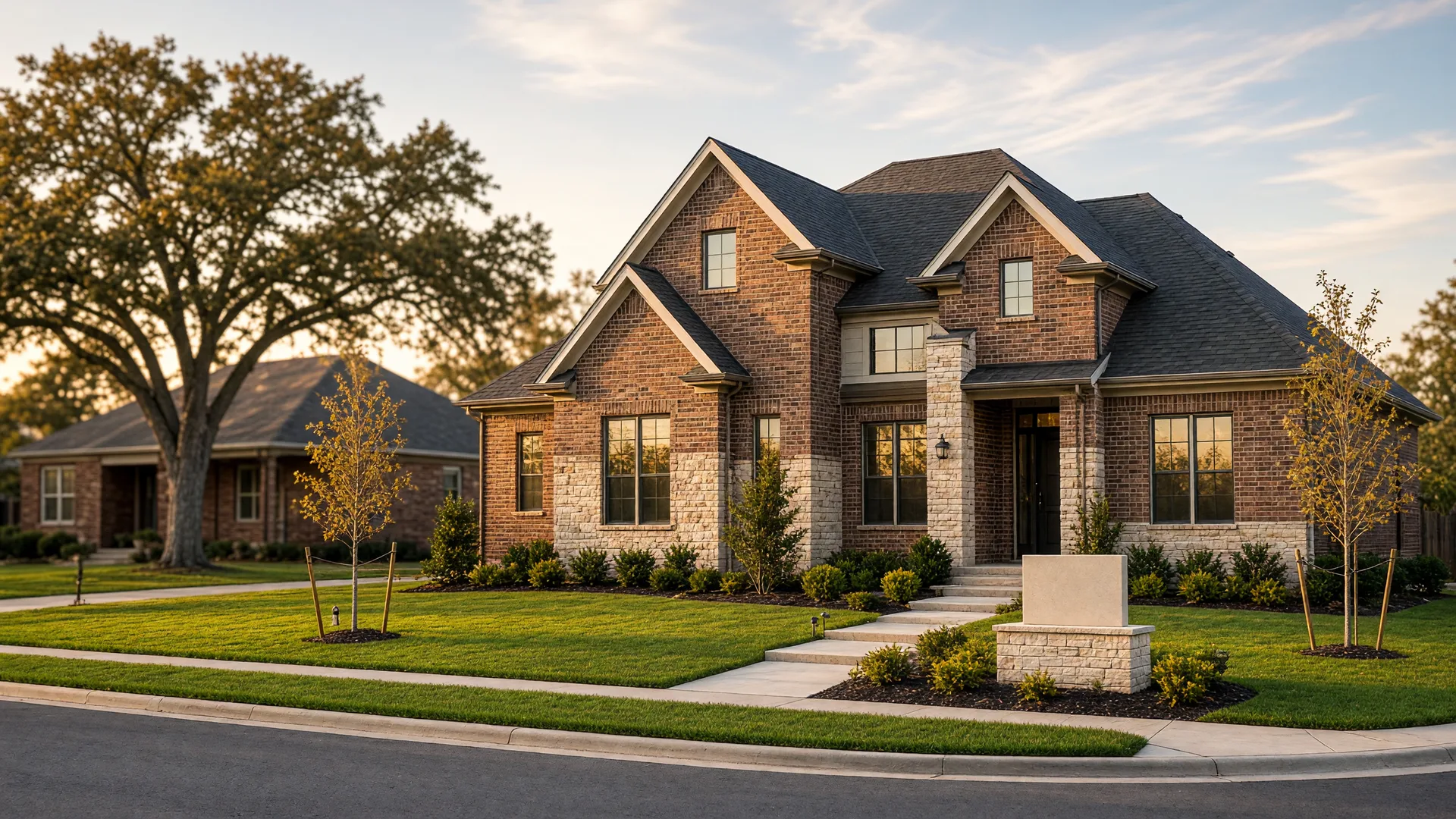
The short answer is that Katy gives you two genuinely different products. A resale in an established neighborhood buys you a mature community, a known tax history, and a Texas contract with an option period that lets you back out for almost any reason. A new build in one of the area's master-planned communities buys you a brand-new home backed by a statutory 1-2-10 builder warranty, but often on the builder's own contract, which does not always include that same escape window. Neither is simply better: they fit different budgets, timelines, and tolerance for unknowns. Here is the honest comparison for Katy and Fulshear buyers in 2026, starting with what each side actually costs.
What new construction costs in Katy and Fulshear right now
Katy and Fulshear are among the busiest new-home corridors in Greater Houston, with most of the inventory concentrated in master-planned communities on or near the Grand Parkway. Based on builder and listing sites accessed in November 2026, the current starting points look roughly like this:
- Sunterra (Katy, 77493): one of the more affordable entry points in the area. DRB Homes advertises plans from about $294,990, ready-to-build plans appear from roughly the mid-$200s, and typical new single-family homes run in the $300,000 to $560,000 range.
- Elyson (Katy, 77493): a large, top-selling community with entry duets from the low $320,000s, single-family ready-to-build plans from roughly $408,000, and larger homes on bigger lots from about $480,000 to $670,000.
- Cross Creek Ranch (Fulshear, 77441): an established master-planned community where entry townhomes and 55-plus plans start in the low $300,000s, typical new single-family homes land in the $450,000 to $625,000 band, and the largest homes run $770,000 to $920,000. Neighboring Cross Creek West opens from the low $400,000s.
- Fulbrook on Fulshear Creek (Fulshear, 77441): the premium side of the area. Homes start in the $500,000s and the largest builder models reach the $860,000 to $980,000 range.
- Jordan Ranch (Fulshear): an established community now in its final phases, with remaining single-family homesites being sold by builders like David Weekley Homes.
Treat every one of those numbers as a starting point, not a quote. Builder pricing shifts with each release, incentives come and go, and a lot premium or an upgraded plan can move the price tens of thousands of dollars. The honest way to shop new construction is to compare the final price on the specific plan and lot, incentives included, against resale homes in the same price range.
What a resale near the same price gets you
For context on the resale side: HAR's September 2026 data put Katy's median sold price around $370,000, and our market snapshot page tracks those numbers month to month. That means resale choices stretch across every budget, from a well-priced first home to the larger inventory of established master-planned communities like Cinco Ranch and Katy proper.
The advantages of an established home are the ones you can see and verify. Mature trees and landscaping that new lots will take a decade to grow. A street of finished homes whose resale values are proven by actual closed sales. A tax bill with years of history, so the annual cost is a known quantity rather than a projection. And crucially for many buyers, an existing home is a used home, priced accordingly: a resale in the same range as a new build usually gives you more square footage, a bigger lot, or a location closer to the city, in exchange for everything inside being a few years older.
The contract: the biggest practical difference
This is where new construction and resale diverge most sharply, and it is the part buyers most often discover too late. On a resale, the standard Texas contract includes a negotiated termination option, commonly 7 to 10 days in the Katy market. You pay the seller a separate option fee, and for that window you can terminate the contract for almost any reason, or no reason, with your earnest money returned in full. Only the option fee is lost. We walk through that window start to finish in our guide to the Texas option period.
New construction is different. TREC does publish new-home contract forms, and those forms carry a similar termination option. But builders are not required to use TREC forms, and in practice most new homes in Texas sell on the builder's own attorney-drafted contract, which typically has no option period and no for-any-reason termination right. On that kind of builder contract, the buyer often cannot walk away for an unlisted reason without risking the earnest money or deposit, and the refund rules are written by the builder, not by a state form.
This is not a reason to avoid new construction. It is a reason to read the contract before you sign, and to have someone who negotiates Texas contracts regularly read it with you. The questions that matter: Can you terminate at all, and for what reasons? What happens to your deposit if construction runs late and you can no longer qualify, or no longer want the home? What happens if the builder goes out of business mid-build? Where is your money held while the home is under construction? The answers are on the page, but only if you look before you sign.
The warranty: what Texas law actually covers
New homes in Texas carry a statutory builder warranty that resales do not. Under Chapter 430 of the Texas Property Code, a builder must warrant a new home for:
- 1 year against defects in workmanship and materials;
- 2 years on the plumbing, electrical, heating, and air-conditioning systems; and
- 10 years on major structural components, including the foundation, framing, and load-bearing walls.
The warranty begins at occupancy or transfer of title, it supersedes implied warranties, and a third-party warranty company cannot reduce its terms, though the builder and the first owner can vary the coverage by written agreement. Many builders also sell an optional, insurance-backed third-party 1-2-10 policy on top of the statutory warranty, which can be worth comparing when two nearly identical homes differ mainly in the warranty paperwork.
One more reality check: Texas has no state license for home builders. The state commission that once registered builders was abolished in 2009, so anyone can hold themselves out as a builder. Licensed electricians and plumbers work under state licenses, and a few cities require local contractor registration, but the builder you are buying from does not hold a Texas builder's license you can look up. That makes the builder's own track record the entire ballgame: how long they have built in the area, how many homes they have completed, how they have handled warranty claims, and whether they are financially stable enough to honor a 10-year structural warranty. Ask, and ask other homeowners who bought from them.
Taxes and MUDs: what a new build adds to the yearly bill
Most new master-planned communities in Katy and Fulshear are served by Municipal Utility Districts, and a brand-new district can still be carrying most of its infrastructure bond debt. That means the MUD tax on the newest sections can run noticeably higher, sometimes more than $1.00 per $100 of assessed value, while an older, established district down the road may have already paid its bonds down to a fraction of that. The same logic applies to the rest of the property tax layers: a resale gives you years of real bills to look at, while a new build's first-year bill is a projection the builder and development team estimate for you. Read the Notice to Purchaser the developer is required to deliver, and compare the total yearly tax on the new home against a comparable resale before you fall in love with a monthly payment.
A subtler point: a brand-new home is generally assessed from its purchase price, and its taxable value can step up the first year or two as the appraisal district catches up to what the neighborhood is worth. A resale with homestead history usually has a more predictable trajectory, which matters when you are budgeting year two and year three of ownership.
Timeline, negotiation, and the appraisal
Resales in Texas typically close in about 30 to 45 days from an accepted offer, as our closing timeline guide lays out. A new build runs on the builder's construction schedule: a move-in-ready spec home can close quickly, but a home built from the ground up ties your closing date to construction progress measured in months, not weeks, and construction dates slip.
Negotiation is different on each side too. On a resale, your leverage is the contract itself: price, repairs found during the option period, and seller concessions such as help with closing costs are all negotiable. With a builder, the list price is usually firmer, but the incentives are real: interest rate buydowns, design-center credits, closing-cost allowances, and sometimes a cash contribution toward your rate. The trade is that you are negotiating with a seller who writes the contract, so every incentive deserves to be read in the context of the final price and the contract terms.
The appraisal deserves its own caution. In an established neighborhood, an appraiser has nearby closed sales to compare against, so a fair offer almost always appraises. In a brand-new subdivision the comparisons are mostly other builder sales, which usually supports the price, but if a section is moving slowly or the neighborhood's resales have sagged, a new-home price can outrun what the appraisal supports. Know before you sign what you would do if the home appraises below the contract price, because that gap has to come from somewhere.
A quick checklist for each path
If you are leaning new construction:
- Compare the final price, lot premium, and incentives against real resale homes in the same range.
- Read the builder's contract for how you can terminate, who holds your deposit, and when you can get it back.
- Ask how the builder's warranty claims have been handled and how long they have built in the area.
- Get the MUD and full property tax projection and compare it to an established home's real bill.
- Have a plan for an appraisal shortfall before the contract locks you in.
If you are leaning resale:
- Use the option period for a licensed inspection, a close read of the Seller's Disclosure, and any negotiated repairs.
- Verify the tax bill, HOA dues, and any remaining MUD debt from the actual property record.
- Compare the age of major systems: roof, HVAC, water heater, and foundation all have real remaining life.
- Budget for updates a pre-owned home will eventually need; the lower purchase price is the trade.
Which one is right for you?
In practice, the right answer comes down to what you value. Buyers who want everything brand new, with modern floor plans, energy efficiency, and a warranty envelope, and who can plan around a construction timeline, are usually happiest in the new communities. Buyers who want more space for the dollar, mature neighborhoods, a known tax bill, and the safety net of an option period usually do better with a resale. And plenty of buyers in Katy end up doing both over time: start in an established home, then order the new build for the next chapter.
The mistake is choosing either path without the numbers in front of you. Starting prices from a builder's website are not the same as a total cost of ownership, and neither is a resale's asking price the same as its real value in today's market.
Want today's real numbers on both sides of the comparison?
We compare new construction and resales every week for buyers across Katy, Fulshear, Cinco Ranch, and the surrounding communities, and we know which builders are delivering on schedule and which resales are genuinely priced right. Bring us the neighborhoods and budget you are considering, and we will lay out the honest comparison: final prices with incentives, real tax projections, and what each home will be worth when you go to sell. Call Carol at (832) 212-2772, send a note through the contact page, or start browsing homes for sale in Katy. No pressure, just straight answers from a broker who negotiates these contracts every day.