
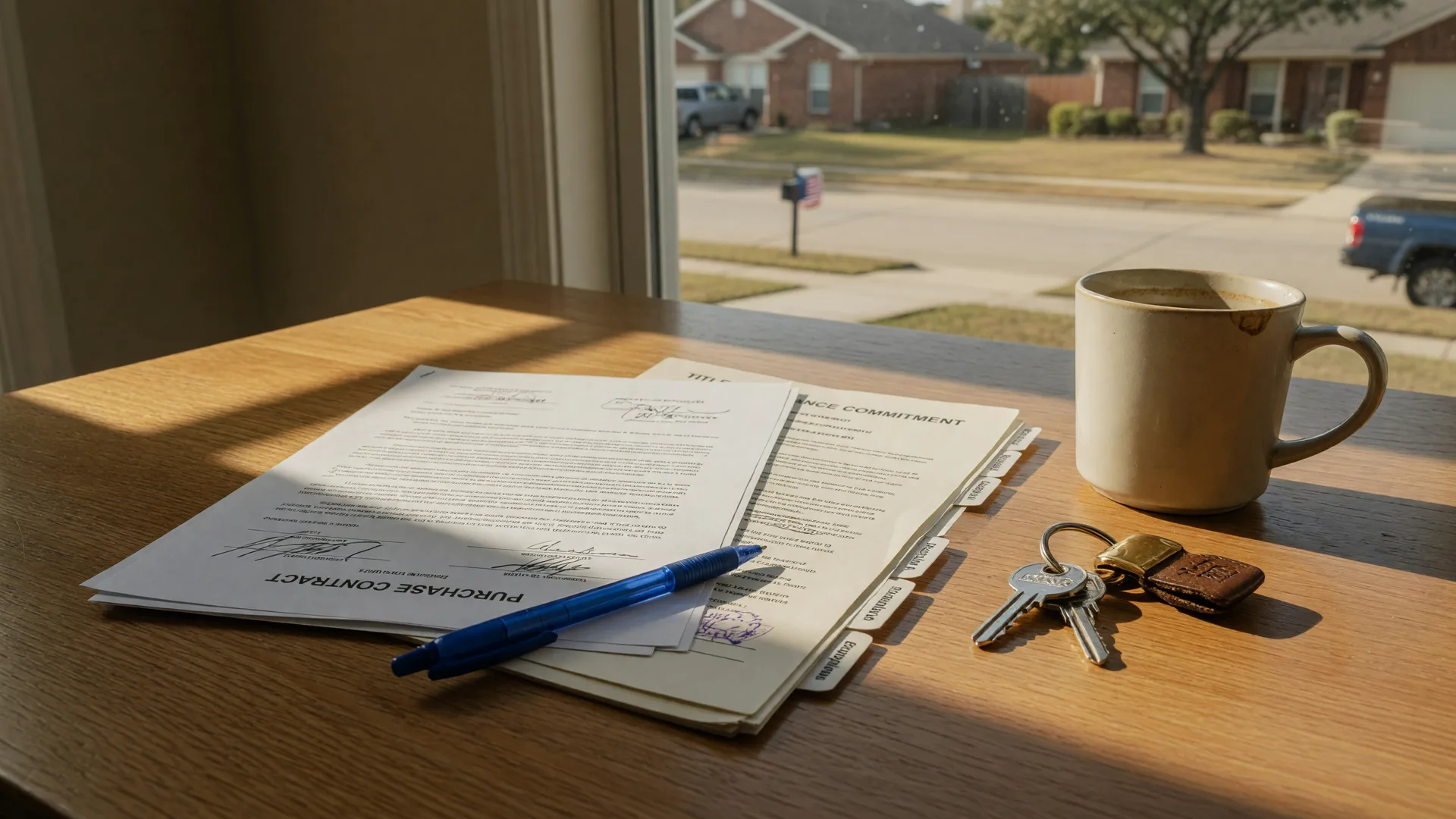
Who pays for title insurance when you buy a home in Texas? In a typical resale transaction, the seller pays for the owner's title policy, the one that protects you as the buyer, and you pay for the lender's title policy, the one that protects your mortgage lender, which costs a flat $100 when it is issued at the same closing. Both arrangements are written into your contract, and both premiums are set by the Texas Department of Insurance (TDI), so the price you see in Katy is the same price anywhere in the state. Here is what the two policies actually cover, what they cost under TDI's 2026 rate schedule, and where the numbers show up on your closing disclosure.
What title insurance actually is
Title insurance does not cover the condition of the house; that is what the home inspection is for. It protects your ownership against hidden problems in the chain of title: a forged signature on a deed from decades ago, a mortgage or lien that was paid off but never released, an undisclosed heir with a claim to the property, or a boundary dispute with a neighbor. Before closing, a title company searches the public records for exactly those kinds of issues. The title policy then backs that search with insurance, so if a problem the search could not reveal turns up later, the policy pays covered losses and legal defense costs up to its limit.
Two things make title insurance different from every other insurance you buy. The premium is paid once, at closing, not monthly or yearly. And the coverage runs by event, not by term: an owner's policy stays in force as long as you, or your heirs, own the home, even if you never file a claim for 20 years.
The two policies: the owner's policy and the lender's policy
Most Texas closings involve two separate policies, and they protect two different parties:
- The owner's policy (T-1 form) protects you, the buyer, up to the purchase price. It covers your legal defense if someone challenges your ownership after closing and pays claims for covered title defects. It lasts as long as you own the home.
- The lender's policy (T-2 form) protects your mortgage lender, up to the outstanding loan balance, for the life of the loan. In almost every financed purchase, the lender requires it as a condition of the mortgage.
If you are paying all cash, there is no lender to protect and no lender's policy in the picture. The owner's policy, however, is still the one that protects you, which is why it is the more important of the two for most buyers.
Who pays for title insurance in Texas?
Under the standard Texas Real Estate Commission (TREC) One to Four Family Residential Contract, the form most Texas resales are written on, who pays for each title policy is a negotiated detail. Paragraph 6A of the contract contains checkboxes for the title policies and the survey, and the box that is marked is the box that controls.
In practice, the customary arrangement in the Katy and Houston market works out like this:
- The seller pays for the buyer's owner's title policy. This is the standard expectation in Texas resales, and it is how most Katy and Houston contracts are written.
- The buyer pays for the lender's title policy. When the policies are issued together at the same closing, this is the flat $100 simultaneous-lender policy under TDI's rate rules.
Because the box is negotiable, confirm it in the contract rather than assuming. In a competitive, multiple-offer situation a buyer might agree to cover the owner's policy to make their offer more attractive, and in a balanced market a seller might sweeten the deal by covering extra title add-ons or settlement fees. None of that is automatic; it is a line in the contract, and reading that line before you sign is exactly the kind of detail a buying agent protects you on.
How much does title insurance cost in Texas?
TDI sets a single statewide basic premium for title insurance, and the current schedule took effect March 1, 2026, roughly 6.2% below the previous rates. Because the state regulates the price, the basic premium is the same in Katy, Houston, or El Paso; what varies between title companies is service quality and settlement fees.
For an owner's policy on the standard schedule:
- A flat $780 for the first $100,000 of coverage;
- then $4.94 per $1,000 of coverage from $100,001 up to $1,000,000.
Worked out on real purchase prices, that means an owner's policy costs roughly:
- about $1,768 on a $300,000 home;
- about $2,015 on a $350,000 home;
- about $2,756 on a $500,000 home.
On around the current Katy median sale price of $370,000, the owner's policy works out to about $2,114. The lender's policy issued at the same closing, under TDI's simultaneous-issue rule, is a flat $100. Endorsements, which are extra coverage options layered onto a policy, add more to the bill when they are included.
What makes the price go down: simultaneous issue and reissue credits
Two TDI rate rules keep title insurance cheaper than it looks at first glance. The first is simultaneous issue (Rate Rule R-5): when the owner's policy and a loan policy are issued at the same closing, on the same date, for the same property, the loan policy costs a flat $100 instead of a premium computed on the full loan amount. That rule is why the buyer's lender policy line on a Katy closing disclosure is so small.
The second is the refinance reissue credit (Rate Rule R-8), which matters when an existing lien has already been insured by a prior loan policy. If a new loan policy is issued within four years, it gets a 50% credit; if the prior policy is more than four but less than eight years old, the credit is 25%; and after eight years the full basic rate applies. This is the discount Katy and Houston homeowners see when they refinance, and it is one more reason to keep the title work from your last closing organized and easy to find.
Do you actually need the owner's title policy?
Your lender will require the lender's policy. The owner's policy is technically optional in Texas, but in a typical resale the seller provides it anyway, and here is the honest truth: it is the policy that protects you, and it is worth having. The title search catches the recorded problems, but it cannot catch everything, such as a payoff that was never filed or a family member who surfaces with a claim years later. The owner's policy is a one-time premium for coverage that lasts as long as you own the home, and it covers your legal defense if your ownership is ever challenged.
Katy's master-planned communities are a good example of why clean title matters. Title work in subdivisions with homeowners associations routinely checks for recorded assessments and unpaid association liens as part of clearing the title, and catching that at a search stage is far cheaper than litigating it after you move in.
How title insurance fits into a Texas closing
In Texas, the title company is usually also the closing agent. It holds the earnest money in escrow, orders the survey, prepares the final closing disclosure, and coordinates the signing and funding. Title insurance is one line among the closing costs, but it is one of the most meaningful, because it is the line that protects your ownership itself.
When you review your closing disclosure, check which policies are listed and who is paying for each one. The owner's policy should appear as a seller-paid item in the typical Katy resale, and the lender's policy as a buyer-paid item around $100. If the numbers look different from the TDI schedule, or if the checkboxes in your contract do not match what the title company is billing, ask before you sign. Nobody can discount the state-regulated basic premium, but settlement fees and closing logistics vary, and a good title company explains every line.
Who pays for title insurance when you refinance?
Refinancing is a buyer-style closing in miniature: a new lender issues a new loan, and a new loan policy is written to protect that lender. In that case, there is no seller, so the borrower pays for the lender's policy, and the reissue credit described above is the main lever that keeps the cost down. If you refinanced recently in Katy or Houston, your title company carries the credit calculation forward from your prior policy, and the numbers will show up on the closing disclosure.
A note on the rules
The rates and rules in this article come from the Texas Department of Insurance title premium schedule effective March 1, 2026, and the TREC One to Four Family Residential Contract as currently in use. Title policy details, checkboxes, and costs are negotiated between the parties, so the contract you sign is always the final word on your deal, and nothing here is legal advice. If you want the title line of a specific transaction explained against today's numbers, ask us directly.
Want to see the title line on your closing math?
The title policy is one of the best-value lines on a Texas closing statement, but only when it is written the right way and priced at the right rate. If you are buying or selling in Katy or Greater Houston, call Carol at (832) 212-2772 or send a note through the contact page, and we will walk you through who pays what, the seller's disclosure and closing checklist, and the current market numbers for the area you are watching. No obligation, and no jargon.